A selection of our work. Client names are kept confidential; the architecture decisions and how we made them are the useful part.
Salesforce / .NET / Integration
A decade-long CRM partnership
Client: an Australian property investment and finance advisory group.
Designing the original CRM on Salesforce
We have been this client's CRM partner for more than a decade. We first designed and built their CRM on Salesforce, with custom objects, formula fields, triggers and Apex tailored to how they work.
Rebuilding it as a CRM they own
As the business grew, they wanted to move off Salesforce for four reasons: licence cost, ownership of their platform and data, flexibility for custom requirements, and tighter integration with their client-facing portal.
So we rebuilt it ourselves as a custom .NET CRM that deliberately mirrors the Salesforce data model we had designed, so records, fields and audit history carried across faithfully. Data moved through an authenticated bulk export from a custom Apex REST service. We then rebuilt the platform behaviour Salesforce normally provides: a declarative formula engine for calculated and roll-up fields, an entity trigger pipeline for workflow, and a safe-update pattern so that editing part of a record never wipes the rest.
Scheduled jobs handle emails, surveys, status changes and data re-sync. The client portal talks to the CRM through dedicated integration endpoints secured with network allowlisting and OAuth2 tokens.
Modernising the investor portal
The client's investor platform was built on .NET Framework 4.8. It ran portfolio tracking, tax and depreciation schedules, long-range investment simulations, billing and a back office, and its framework, data layer and several libraries had reached end of life.
We rebuilt it on .NET 8 with one rule: users should notice nothing. We kept the original data-access interface and gave it a new Entity Framework Core engine, so every existing query carried over unchanged. Database migrations adopt the live schema instead of altering it. Existing passwords are verified in their legacy format and upgraded the next time each user signs in, so nobody had to reset.
The platform talks to more than fifteen external services, including accounting, lending, depreciation, payment and mobile push providers. We rebuilt each integration as its own service and replaced abandoned libraries with supported ones. When the accounting provider retired its old access model, we planned and completed the cutover across all environments before the deadline.
Quality was built in: a security audit with every high-priority finding fixed, new automated tests for the tax and finance calculations, and browser-driven tests across every page.
The result
The CRM has run the client's business every day for over a decade. The .NET platform we built for them later became the foundation of ArcusOffice, our own CRM product.
ArcusOffice, a CRM where one customer can never see another's data
Our own product, heading to launch.
ArcusOffice is our own CRM for service businesses. It started life as a bespoke CRM for a single client, and we are rebuilding it as a multi-tenant platform on .NET 10 and PostgreSQL. It is not generally available yet.
Isolation, designed in four layers
The hardest problem in a shared CRM is not features, it is isolation. Every query is automatically filtered to the signed-in organisation, and an empty tenant returns nothing rather than everything. Every write is stamped with its owner, and any attempt to move a record to another organisation is rejected. Raw database access must carry an explicit tenant check, enforced by automated build guards. Underneath all of that, PostgreSQL row-level security enforces the same rule inside the database itself, so a bug in application code still cannot cross the line.
One build, any deployment shape
The same build can run as shared SaaS, a private dedicated instance or a self-hosted install, on our own infrastructure or with a cloud provider. Deployment shape is configuration, never a code fork. Background jobs, email and stored credentials all follow the same tenant rules.
Proved by tests
We prove the isolation with an adversarial test suite that attacks one organisation from another, and fails the build if a new data type ever skips the rules.
A release pipeline with testing built into the architecture
Our own product, ArcusOffice.
For ArcusOffice, we designed the path to production before we needed it.
Environments, not drifting branches
We use trunk-based development with four environments: local, system integration testing, user acceptance testing and production. Environments are places we deploy a specific build, not branches that slowly drift apart. Each environment runs as its own service with its own database and its own restricted database account. Nothing is exposed directly to the internet, and the database only listens locally. Schema changes are applied by a separate privileged account, never by the running application, and backups carry the security policies with them.
Layered testing
Automated tests attack one organisation from another on every build. Each functional area then gets its own test lane, and a build is only promoted once every lane is green. We also run concurrent multi-user browser tests to confirm that organisations stay isolated when many people are working at once.
If a test can be automated, we automate it. If it needs a human, we build the loop for one.
ART SG is the design system we built for our own products. ArcusOffice, the CRM we are taking to launch, is built on it. We run it the way we run any system we architect: a clear contract, versioned releases, and tests that catch a regression before a user does.
A design system is architecture for the front end
The screen is where an architecture is most visible, and often where it frays first. Colours get copied by hand, buttons drift apart, and every page solves dark mode its own way. A design system fixes that the way a well-designed back end does: shared building blocks, rules for how they fit together, and a record of every change.
Tokens, components and a contract
Every colour, space and type size is a named design token. Each colour is declared once, with its light and dark values side by side, and that one declaration drives the light, dark and high-contrast modes. A right-to-left build comes from the same source.
On top of the tokens sit 39 component stylesheets and 26 JavaScript components. Every script component follows the same lifecycle: it can be started on any part of a page and destroyed cleanly, which matters in an application that changes content without reloading. The fonts are self-hosted and there are no runtime dependencies, so nothing is fetched from a third party.
Versioned like any other product
ART SG uses semantic versioning. It has had 23 releases since December 2025, each one recorded in a changelog, and version 2.0.0 came with a migration guide for its breaking changes. Products that use it can choose when to upgrade, instead of finding out when something looks wrong.
Tested, not just documented
Every change runs through an automated test suite before it is released:
490 computed-style baselines: 49 pages, each checked in 10 combinations of colour mode and screen size, so an unplanned change to a rendered style fails the run.
Contrast checks on text in every mode, and a guard that fails if a page scrolls sideways at phone width.
66 behaviour tests for the interactive components.
Smoke runs in Firefox and WebKit as well as Chromium.
See it running
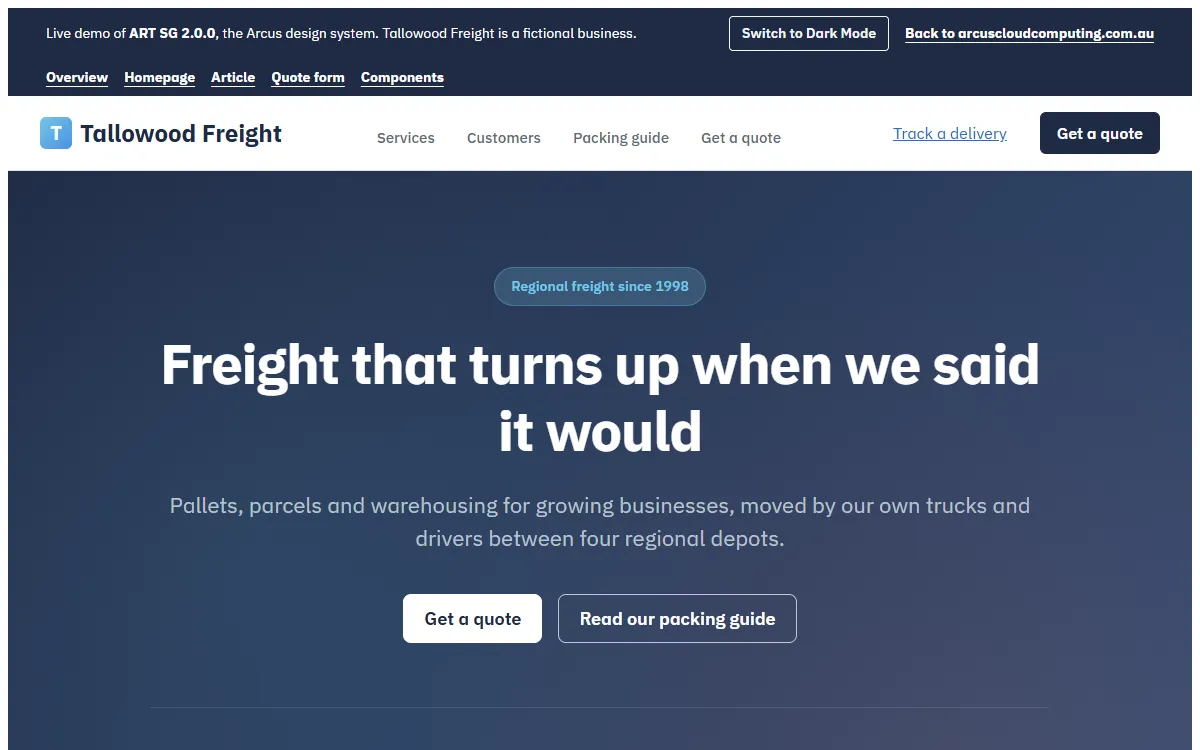
The demo homepage, built with ART SG 2.0.0 and no page-level CSS.
The live demo shows ART SG 2.0.0 on a homepage, an article, a form and a components page for a fictional freight company. It uses the published files exactly as they ship, and you can switch between light and dark mode as you go. This website has its own lighter stylesheet, so the demo pages stand on their own.
Client: an Australian business with a public registration form on its website.
Cyber attacks on Australian businesses are increasingly in the news. Not all of them are headline data breaches. Many are automated, and they go after the ordinary parts of a website that nobody thinks of as a target, like a sign-up form.
What happened
Over about five weeks in September and October 2026, a bot sent thousands of automated submissions to a client's public registration form. Most arrived in a single burst of about a week. The submissions were posted directly to the server rather than through the page, and each used a different real person's email address. It was most likely subscription bombing: victims' addresses are fed into many sign-up forms so their inboxes flood with confirmation emails. The form was being used to send unwanted email to strangers.
No existing customer record was changed.
What we changed
A CAPTCHA that fails closed. We added Cloudflare Turnstile. If it is misconfigured or cannot be reached, the submission is rejected rather than let through.
A honeypot field that people never see. If it is filled in, the visitor sees the normal thank-you page, but nothing is saved or sent.
Throttling per IP address and across the whole site, so a burst cannot become thousands of emails.
No overwriting from the public form. We removed a path that let an existing registration be overwritten, and a method that was reachable from the internet when it should not have been.
Authentication on every administrative POST, not just on the pages that display the forms.
The automated records were exported and backed up, then removed, leaving the genuine records in place.
The lesson
Every public form is part of your attack surface. Protection works best in layers, and it should fail safe: when a check can't run, the answer is no. We apply the same layered approach to the enquiry form on this website.